Understanding RTP & Risk in Online Games
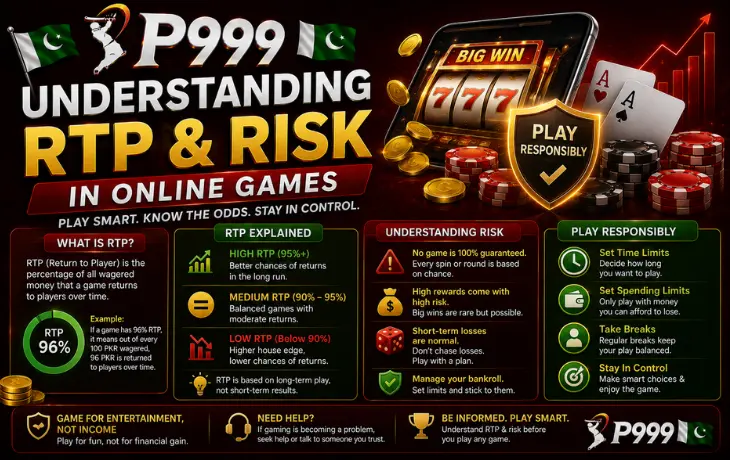
Understanding RTP & Risk starts with two simple ideas: how games pay back over time, and how much a game’s results swing from one round to the next. Both terms get thrown around a lot, often without much explanation.
This guide breaks down what RTP actually means, what volatility is, and how the two work together to describe a game’s overall risk. We’ll also be clear about what these concepts can’t tell you.
This is educational content only. Outcomes in games involving chance cannot be predicted, and nothing here guarantees any result.
Quick Answer: RTP, or Return to Player, is a long-term average of how much a game pays back across a very large number of rounds. It doesn’t predict what happens in any single session, and it never guarantees a win. Volatility describes how big and how frequent the wins and losses tend to be along the way.
What Does RTP Mean?
RTP stands for Return to Player. It’s a way of describing, on average, how much money a game returns to players over a very large number of rounds.
RTP Explained simply: if you spun a slot millions of times, the RTP tells you roughly what percentage of total money wagered would come back as winnings across all those spins combined. It says nothing about any single spin, hand, or round you personally play.
What Is Return to Player (RTP)?
Return to Player is a long-term mathematical concept, not a promise about what happens during your session. It’s calculated using probability across an enormous number of outcomes.
Because it’s a long-term average, RTP can only be meaningfully observed over millions of rounds, far more than any individual player will ever play. This is why RTP describes the game itself, not your personal results.
Important Notice: We do not have officially verified RTP figures for specific games on this platform. Avoid trusting any source that states exact percentages for a particular game without a verifiable, official source.
How RTP Works
RTP is built from probability, not from any pattern in how a game “decides” to pay out.
| Concept | Explanation |
|---|---|
| Long-term average | RTP describes results across millions of rounds, not a single session |
| Independent rounds | Each round or spin is generated independently of previous ones |
| No memory | A game doesn’t “remember” past results to balance things out |
| Applies to the game, not the player | Your personal results can differ significantly from the long-term average |
Think of it like flipping a fair coin. Over ten thousand flips, you’d expect close to 50% heads and 50% tails. But over just ten flips, getting seven heads and three tails wouldn’t be unusual at all. RTP works the same way, just applied to game outcomes instead of coin flips.
Does RTP Guarantee You Will Win?
No. This is one of the most important things to understand about RTP, and one of the most commonly misunderstood.
RTP is a statistical average calculated over an enormous number of rounds. It says nothing about whether your next spin, hand, or bet will win or lose. You could play a game with any RTP and still lose your entire balance in a short session, purely due to normal random variation.
Random Outcomes don’t follow a schedule. There’s no mechanism that ensures wins arrive at any particular pace, regardless of what RTP a game might have.
What Is Volatility?
Volatility, sometimes called variance, describes how big and how often wins and losses tend to be in a game.
A simple real-life comparison helps here. Imagine two savings approaches: one where you get a small, steady amount every week, and another where you might get nothing for months and then a large lump sum unexpectedly. Both could average out to the same total over a year, but they feel very different to experience. Game volatility works the same way.
High Volatility vs Low Volatility
These two patterns describe very different playing experiences, even if the long-term average return were somehow identical.
High Risk vs Low Risk Games
| Volatility Level | Typical Pattern | Player Experience |
|---|---|---|
| Low volatility | Smaller, more frequent wins | Steadier balance, fewer big swings |
| High volatility | Larger, less frequent wins | Balance can dip for longer stretches, with bigger payouts when they happen |
Neither pattern is inherently better. Low volatility can feel less stressful but less exciting, while high volatility can feel exciting but comes with longer stretches of no wins.
RTP vs Volatility
These two ideas answer different questions, and mixing them up is one of the most common sources of confusion.
RTP vs Volatility Comparison
| Factor | RTP | Volatility |
|---|---|---|
| What it measures | Long-term average payback percentage | How wins and losses are distributed over time |
| Time frame | Millions of rounds | Can be felt within a single session |
| Tells you | Roughly what a game returns on average, long-term | How bumpy or smooth your short-term experience might be |
| Predicts your next result | No | No |
A game can have the same general RTP category as another game while feeling completely different to play, simply because of volatility differences.
What Does Game Risk Mean?
Game Risk Levels combine both RTP and volatility into a broader sense of how unpredictable a game’s short-term results can be.
A higher-volatility game generally carries more short-term risk, since your balance can swing more dramatically between wins. This doesn’t mean the game is “worse,” just that the experience of playing it is less steady session to session.
Things Every Beginner Should Know
- RTP is a long-term average, not a short-term prediction.
- Volatility affects how choppy your results feel, separate from RTP.
- No combination of RTP and volatility guarantees a specific outcome for you.
- Every round or spin in a chance-based game is generated independently.
Skill-Based vs Chance-Based Games
Not every game on a gaming platform carries risk and outcomes in the same way.
Skill vs Chance Games
| Game Type | Outcome Influence | Examples |
|---|---|---|
| Skill-based | Player decisions meaningfully affect results | Strategic card decisions, timing-based choices |
| Chance-based | Outcomes are generated randomly, largely independent of player choice | Slot spins, roulette, dice-based games |
| Mixed | Combines chance-based outcomes with some decision-making | Games like Teen Patti, where betting decisions matter even though card outcomes are random |
Games like Aviator rely heavily on timing decisions layered over a fundamentally random event. Slot-style games in our Games Hub and Live Casino tables lean more toward pure chance once a bet is placed.
Common Myths About RTP
A few misunderstandings about RTP and risk come up again and again.
Myth vs Fact:
- Myth: A game is “due” for a win after a losing streak. Fact: Each round is independent, and past results don’t influence future ones.
- Myth: Higher RTP means you’ll definitely win more often in a short session. Fact: RTP only describes long-term averages across millions of rounds, not your specific session.
- Myth: Volatility can be predicted round to round. Fact: Volatility describes a general pattern over time, not a specific upcoming result.
- Myth: Playing longer guarantees the RTP will “even out” in your favor. Fact: Longer play means more rounds closer to the mathematical average, but it doesn’t guarantee a personal profit.
Common Misunderstandings
- Believing RTP applies to a single session rather than millions of rounds.
- Assuming a specific unverified RTP number applies to every version of a game.
- Treating volatility as a predictable pattern instead of a general tendency.
- Confusing skill-based decision-making with control over a chance-based outcome.
Tips for Responsible Gaming
Understanding RTP and volatility is useful, but it doesn’t remove the genuine risk involved in real-money games.
Responsible Gaming Reminder: Set a budget and a time limit before you start playing, and stop once you reach either one. Our full Responsible Gaming Guide covers this in more detail.
Responsible Gaming Tips:
- Treat every session as entertainment, not a way to generate income.
- Decide your budget in advance, regardless of what you know about RTP or volatility.
- Avoid chasing losses by increasing bets after a losing streak.
- Take breaks between sessions rather than playing for long, uninterrupted stretches.
- Never use money meant for essentials to fund play.
If gaming ever starts to feel like it’s affecting your daily life, our Trust and Safety page and Responsible Gaming Guide both point to resources worth reading.
Why Understanding RTP & Risk Matters
Knowing how these concepts work won’t change the odds of any individual round, but it does change how you interpret what happens while playing. A losing stretch on a high-volatility game isn’t a sign that something is wrong, and a winning stretch on any game isn’t proof that a strategy is working.
This kind of context matters most when it shapes real decisions, like how much to budget for a session or when to stop. Treating RTP and volatility as background knowledge, rather than a tool for predicting results, keeps expectations realistic.
Players who understand these ideas tend to make steadier decisions about bet sizing and session length, simply because they’re not chasing patterns that don’t exist. That shift in mindset is arguably more useful than any specific number could be.
Frequently Asked Questions
What is RTP in simple terms? RTP, or Return to Player, is a long-term average showing roughly what percentage of wagered money a game returns to players across millions of rounds.
Does a high RTP mean I will win more?
Not necessarily in the short term. RTP describes a long-term mathematical average, not what happens in your individual session.
What is volatility in gaming?
Volatility describes how big and how frequent wins and losses tend to be. Low volatility means smaller, steadier results, while high volatility means bigger swings with longer gaps between wins.
Can RTP predict my next spin or hand? No.
RTP is a long-term statistic and cannot predict any individual round, spin, or hand.
Are skill-based games less risky than chance-based games?
Skill can influence some decisions, like betting choices, but many outcomes still depend on chance. Neither category eliminates risk.
Why don’t you list specific RTP numbers for games?
We don’t have officially verified RTP figures for specific games, so we avoid stating numbers that can’t be confirmed as accurate.
Is volatility the same as RTP?
No. RTP measures long-term average payback, while volatility measures how choppy or smooth your results feel along the way. They answer different questions.
Does understanding RTP and Risk make gaming safer?
It helps you set realistic expectations, but it doesn’t remove financial risk. Responsible budgeting and time limits matter more for staying safe.
Where can I learn more about responsible play?
Our Responsible Gaming Guide covers budgeting, time limits, and recognizing warning signs in more detail.
Where can I find more general answers about the platform?
Our FAQs Hub covers common questions across download, login, deposits, bonuses, and more.
Final Thoughts
RTP and volatility describe how a game behaves mathematically over time, but neither one predicts what will happen to you personally in any single session. Random Outcomes and Game Probability work the same way regardless of how much you understand the theory behind them.
Key Takeaways:
- RTP is a long-term average, not a short-term guarantee.
- Volatility describes how bumpy or smooth results tend to feel.
- No combination of the two guarantees a specific personal outcome.
- Responsible budgeting matters more day to day than any statistical concept.
If you want to explore how these ideas apply across different game types, our Games Hub covers everything from Teen Patti to Aviator and our Live Casino and Slots pages. Visit our homepage for a full overview of everything available on the platform.